
Backgammon dice odds
Last updated 28 October 2026
Two dice make 36 rolls, and every chance in backgammon is a count of them. A checker left alone 6 pips in front of an opponent’s checker is hit by 17 rolls of 36, nearly half the time; 7 pips away, by only 6. A checker on the bar comes in with 35 rolls against one closed point, and with 11 against five.
The 36 rolls
Each die has six faces, so two dice give 6 × 6 = 36 rolls. 6-5 and 5-6 count as two different rolls, which is why a mixed roll is twice as likely as a double.
- One number you need, on either die: 11 rolls of 36, or 31%. Say you need a 6: six rolls have a 6 on the first die, six on the second, and 6-6 is counted in both.
- Any double: 6 of 36, 1 roll in 6.
- One exact double, such as 6-6: 1 of 36.
- One exact mixed roll, such as 6-5: 2 of 36.
- An average roll moves 8 pips (8⅙ exactly), counting a double as four moves.
The chance to hit a lone checker
A checker alone on a point can be hit by an opponent’s checker that lands on it. Distances are in pips, one pip per point. Within 6 pips, every roll showing that number hits it: 11 rolls with one die. Rolls whose two dice add up to the distance hit too, and so do doubles. Further than 6 pips, only those count, which is why a checker 7 pips away is much safer than one 6 away.
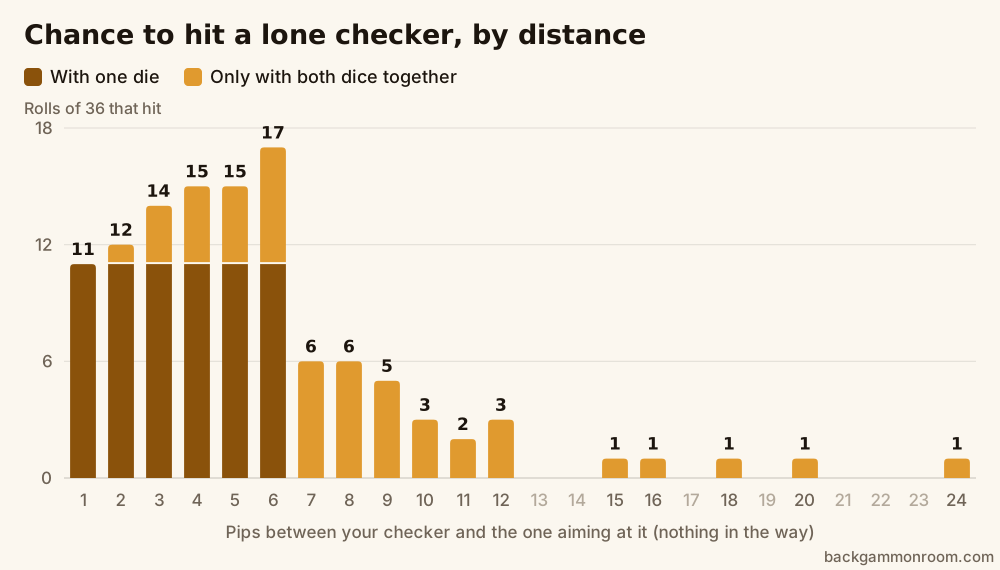
| Pips away | With one die | Only with both dice | Rolls of 36 | Chance |
|---|---|---|---|---|
| 1 | 11 | – | 11 | 31% |
| 2 | 11 | 1 | 12 | 33% |
| 3 | 11 | 3 | 14 | 39% |
| 4 | 11 | 4 | 15 | 42% |
| 5 | 11 | 4 | 15 | 42% |
| 6 | 11 | 6 | 17 | 47% |
| 7 | – | 6 | 6 | 17% |
| 8 | – | 6 | 6 | 17% |
| 9 | – | 5 | 5 | 14% |
| 10 | – | 3 | 3 | 8% |
| 11 | – | 2 | 2 | 6% |
| 12 | – | 3 | 3 | 8% |
| 15 | – | 1 | 1 | 3% |
| 16 | – | 1 | 1 | 3% |
| 18 | – | 1 | 1 | 3% |
| 20 | – | 1 | 1 | 3% |
| 24 | – | 1 | 1 | 3% |
No roll hits from 13, 14, 17, 19 or 21 to 23 pips away. The table assumes nothing is in the way. A roll that needs both dice must stop on the way, after one die: if the points where it would stop are closed (two or more of your checkers on each), that roll can’t hit. So points you hold between your checker and your opponent’s make it safer.
The same counting tells you how many rolls hit when two of your opponent’s checkers aim at the same checker: count each roll once, even when both could hit with it.
Coming in from the bar
A checker on the bar comes back into your opponent’s home board on the point that matches one of your dice, unless that point is closed (two or more of their checkers). It needs one die that shows an open point.
| Closed points | One checker comes in | Stays out | Two on the bar: both come in |
|---|---|---|---|
| 0 | 36 (100%) | 0 (0%) | 36 (100%) |
| 1 | 35 (97%) | 1 (3%) | 25 (69%) |
| 2 | 32 (89%) | 4 (11%) | 16 (44%) |
| 3 | 27 (75%) | 9 (25%) | 9 (25%) |
| 4 | 20 (56%) | 16 (44%) | 4 (11%) |
| 5 | 11 (31%) | 25 (69%) | 1 (3%) |
| 6 | 0 (0%) | 36 (100%) | 0 (0%) |
With two checkers on the bar, both come in only when both dice show open points (a double of an open point brings in both and moves on). Against a closed board, all six points, no roll comes in: you wait until a point opens.
Bearing off your last two checkers
The chance to take both checkers off in one roll, by the points they’re on. Find the farther checker’s point down the side and the nearer one’s across the top. A die can take off a checker from its own point, or from the highest point you still hold when the die is bigger.
| Farther checker on, nearer checker on | 1 | 2 | 3 | 4 | 5 | 6 |
|---|---|---|---|---|---|---|
| 1 | 100%36 | |||||
| 2 | 100%36 | 72%26 | ||||
| 3 | 94%34 | 69%25 | 47%17 | |||
| 4 | 81%29 | 64%23 | 47%17 | 31%11 | ||
| 5 | 64%23 | 53%19 | 39%14 | 28%10 | 17%6 | |
| 6 | 42%15 | 36%13 | 28%10 | 22%8 | 17%6 | 11%4 |
One checker left comes off with any roll from your 1-, 2- or 3-point. From your 4-point it misses only with 2-1 (34 rolls of 36), from your 5-point it comes off with 31, and from your 6-point with 27.
So near the end, checkers on high points cost you rolls: two checkers on your 2-point come off with 26 rolls of 36, two on your 6-point with only 4, a double of 3 or more.
Using the numbers
- Before leaving a checker alone, count the rolls that hit it. Leave it 7 or more pips from your opponent’s checkers and 6 rolls or fewer hit it.
- When you hit, look at how many points of your home board are closed: against four closed points, your opponent stays on the bar with 16 rolls of 36.
- Near the end of a race, fewer checkers on high points means fewer rolls that miss. Counting pips tells you who’s ahead.
In Backgammon Room, the coach often counts for you after a game: when a play leaves a checker to be hit, Pip’s explanation can say how many rolls hit it, and how many hit after the better play.
Questions
- What are the odds of rolling a double?
- 1 in 6: 6 of the 36 rolls are doubles. Two doubles in a row come 1 time in 36.
- What’s the chance of rolling a given number?
- 11 of 36, or 31%, for one number on either die, and 20 of 36, or 56%, for either of two numbers (say a 5 or a 6).
- Why is a checker 6 pips away hit more often than one 1 pip away?
- Both are hit by the 11 rolls that show the number, but 6 pips can also be made with 5-1, 4-2, 3-3 and 2-2: 6 more rolls, 17 in all. 1 pip can only be hit with a 1.
- Are the dice fair in Backgammon Room?
- Yes, and you can check them: every game’s dice are locked before the first roll. Fair dice you can check explains how, and how often fair dice give streaks that feel rigged.
See also: the rules of backgammon, the best play for each opening roll and how to set up the board.