
The best opening moves
Last updated 28 October 2026
A backgammon game can start with 15 different rolls, since the first move is never a double, and each has a best play. With 3-1, 4-2, 6-1, 5-3 and 6-4, make a point. With 6-5, run a back checker to safety. With the other nine, move one back checker up and bring one checker down from your 13-point.
Each play below is the one GNU Backgammon, a strong backgammon program, rates best. When other plays are almost as good, within about 1% winning chances, they’re listed as also fine: at that level, nobody loses a game over the choice. Points are counted from your side, from 24 where your back checkers start down to 1; how to set up the board has the numbers on a diagram.
All 15 at a glance
| Roll | Best play | Notation |
|---|---|---|
| 3-1 | Make your 5-point | 8/5 6/5 |
| 4-2 | Make your 4-point | 8/4 6/4 |
| 6-1 | Make your 7-point | 13/7 8/7 |
| 5-3 | Make your 3-point | 8/3 6/3 |
| 6-4 | Make your 2-point | 8/2 6/2 |
| 6-5 | Run: 24 to 13 | 24/13 |
| 6-3 | One up, one down: 24 to 18, 13 to 10 | 24/18 13/10 |
| 6-2 | One up, one down: 24 to 18, 13 to 11 | 24/18 13/11 |
| 5-4 | One up, one down: 24 to 20, 13 to 8 | 24/20 13/8 |
| 5-2 | One up, one down: 24 to 22, 13 to 8 | 24/22 13/8 |
| 5-1 | One up, one down: 24 to 23, 13 to 8 | 24/23 13/8 |
| 4-3 | Two down: 13 to 10, 13 to 9 | 13/10 13/9 |
| 4-1 | One up, one down: 24 to 23, 13 to 9 | 24/23 13/9 |
| 3-2 | One up, one down: 24 to 21, 13 to 11 | 24/21 13/11 |
| 2-1 | One up, one down: 24 to 23, 13 to 11 | 24/23 13/11 |
Make a point
Five rolls let two checkers land together on an empty point. Two checkers on a point can’t be hit, and every point you make blocks your opponent’s back checkers. When a roll makes a point, make it: 3-1 is the best roll to start a game with, then 4-2 and 6-1.
-
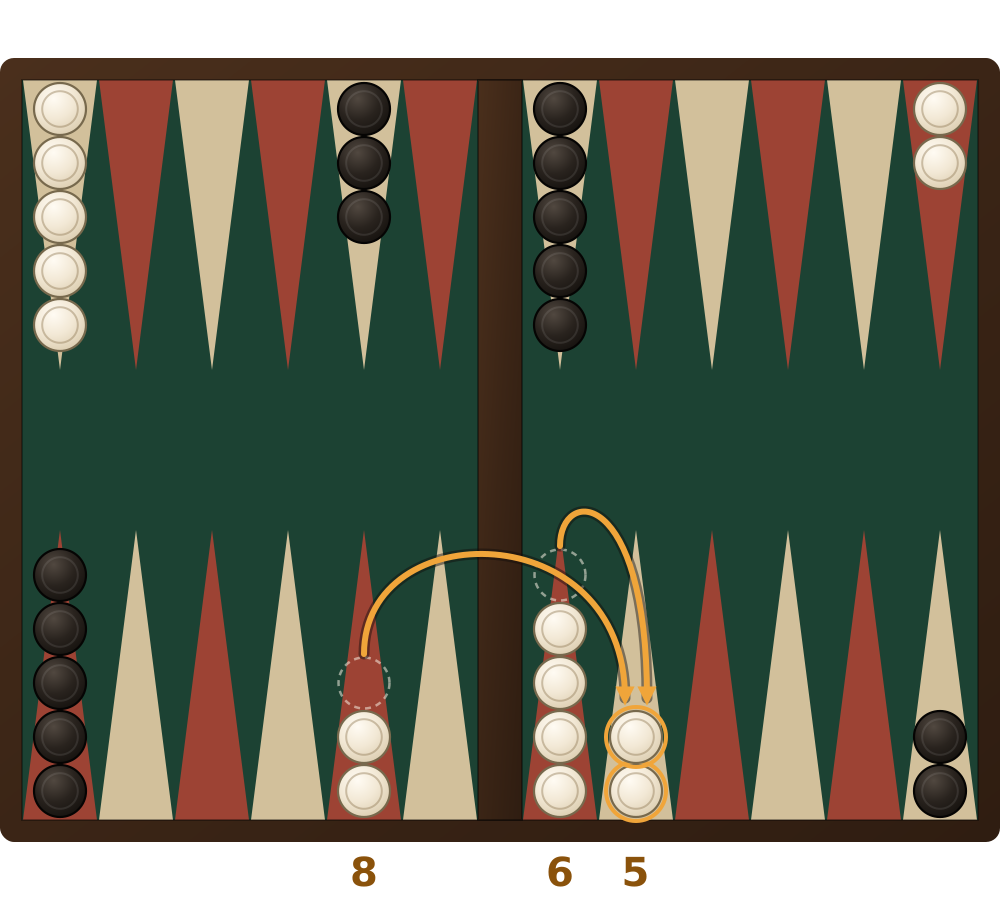
3-1
Make your 5-pointOne checker from your 8-point and one from your 6-point, both to your 5-point.
The best point to own early: it blocks your opponent’s back checkers and starts your home board.
In notation: 8/5 6/5
-
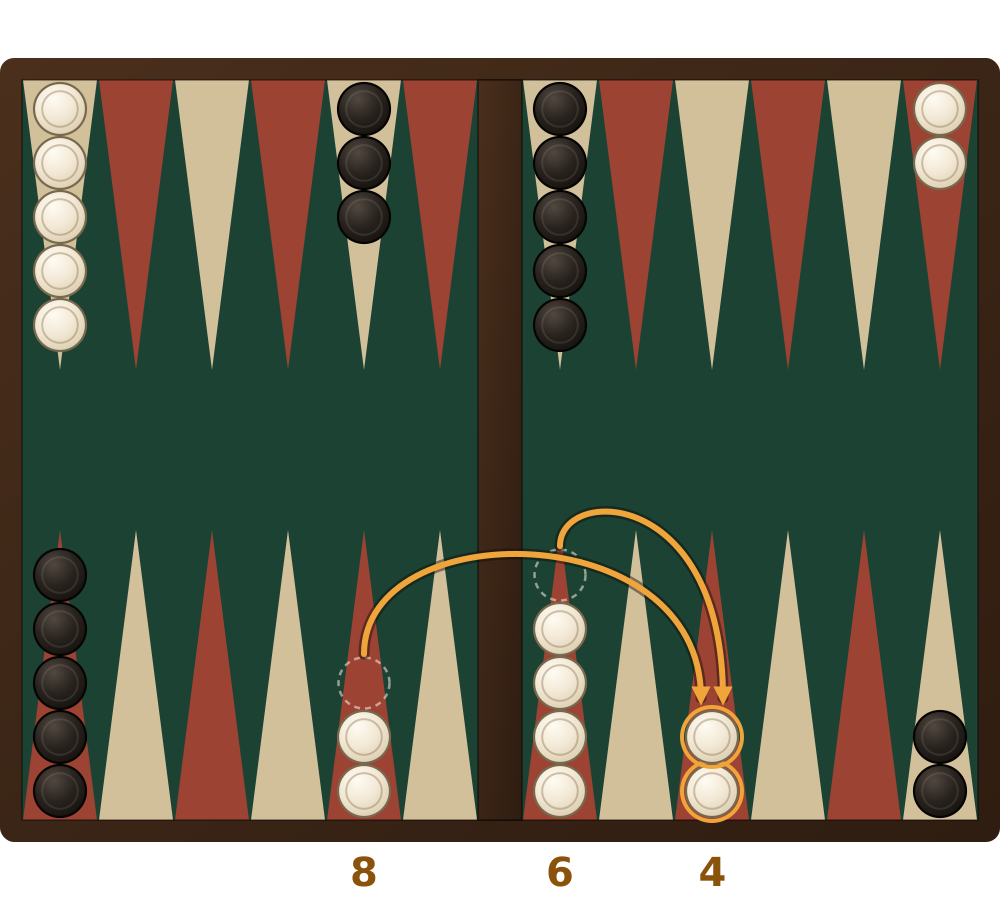
4-2
Make your 4-pointOne checker from 8 and one from 6, both to your 4-point.
A second point in your home board: a checker you hit later will find it harder to come back in.
In notation: 8/4 6/4
-
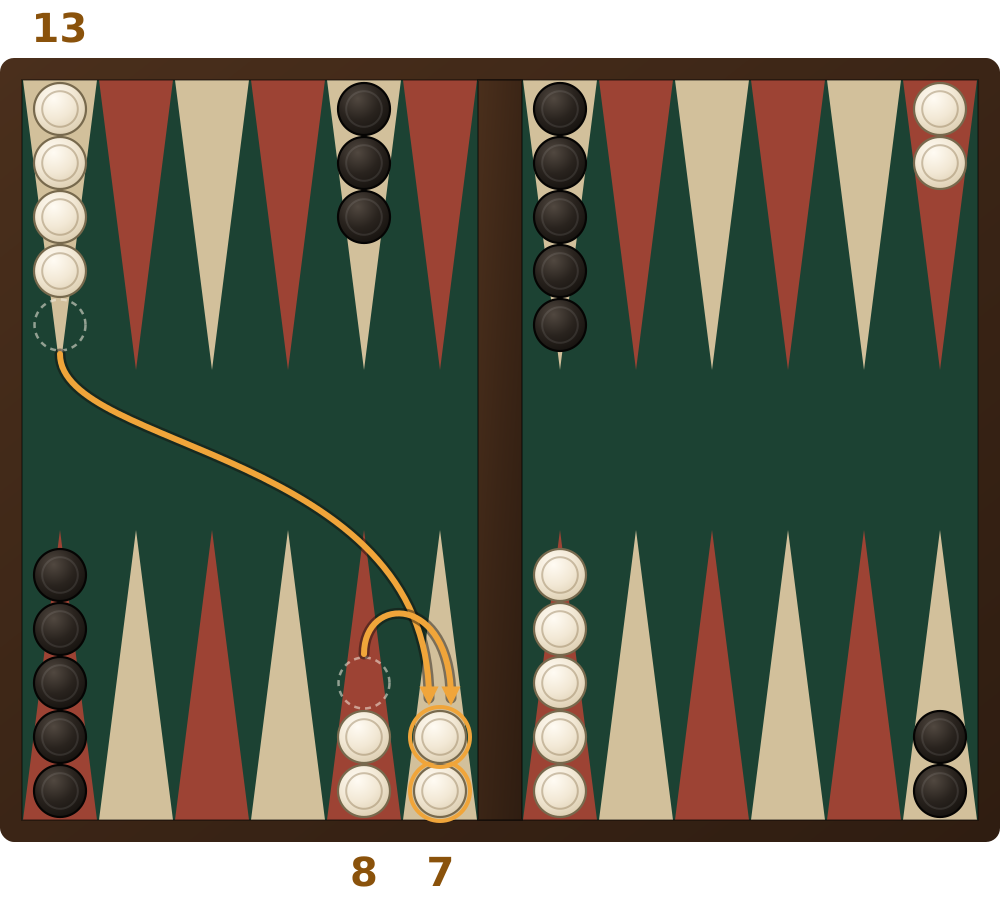
6-1
Make your 7-pointOne checker from 13 and one from 8, both to your 7-point, next to the bar.
With your 8- and 6-points, it makes three points in a row in front of your opponent’s back checkers.
In notation: 13/7 8/7
-
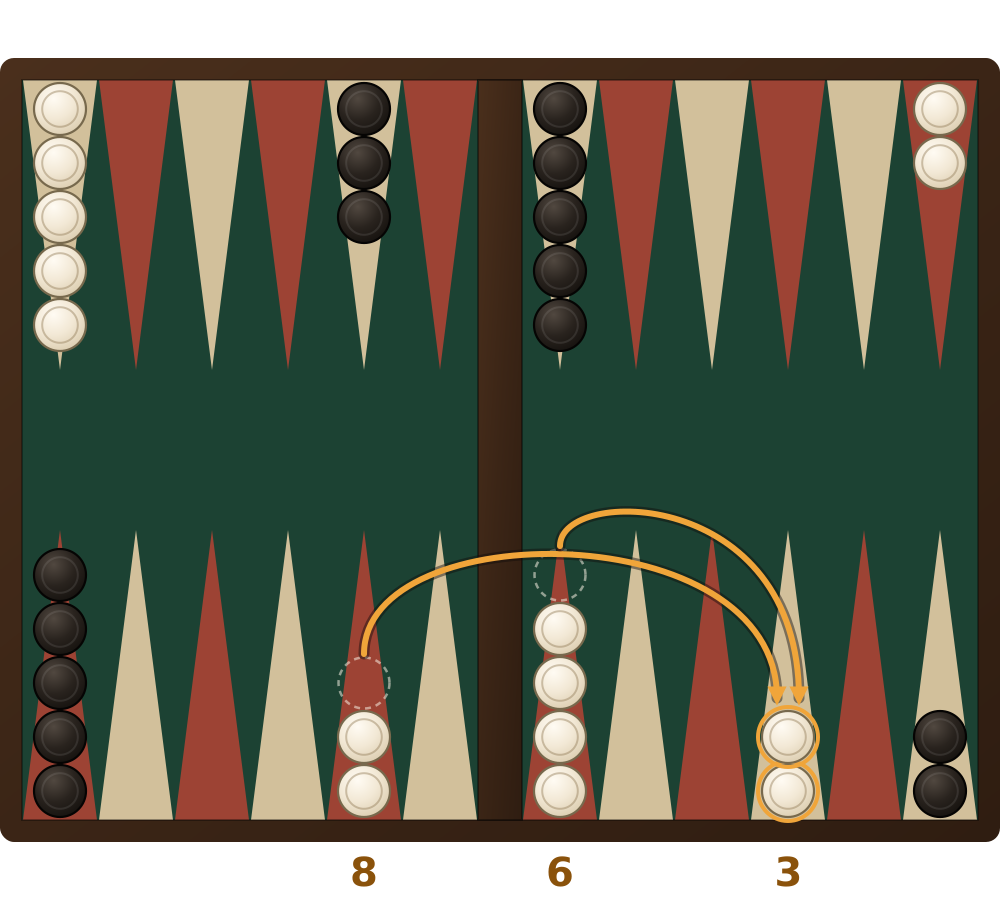
5-3
Make your 3-pointOne checker from 8 and one from 6, both to your 3-point.
Deep in your home board, but a point all the same: better than two checkers left alone.
In notation: 8/3 6/3
-
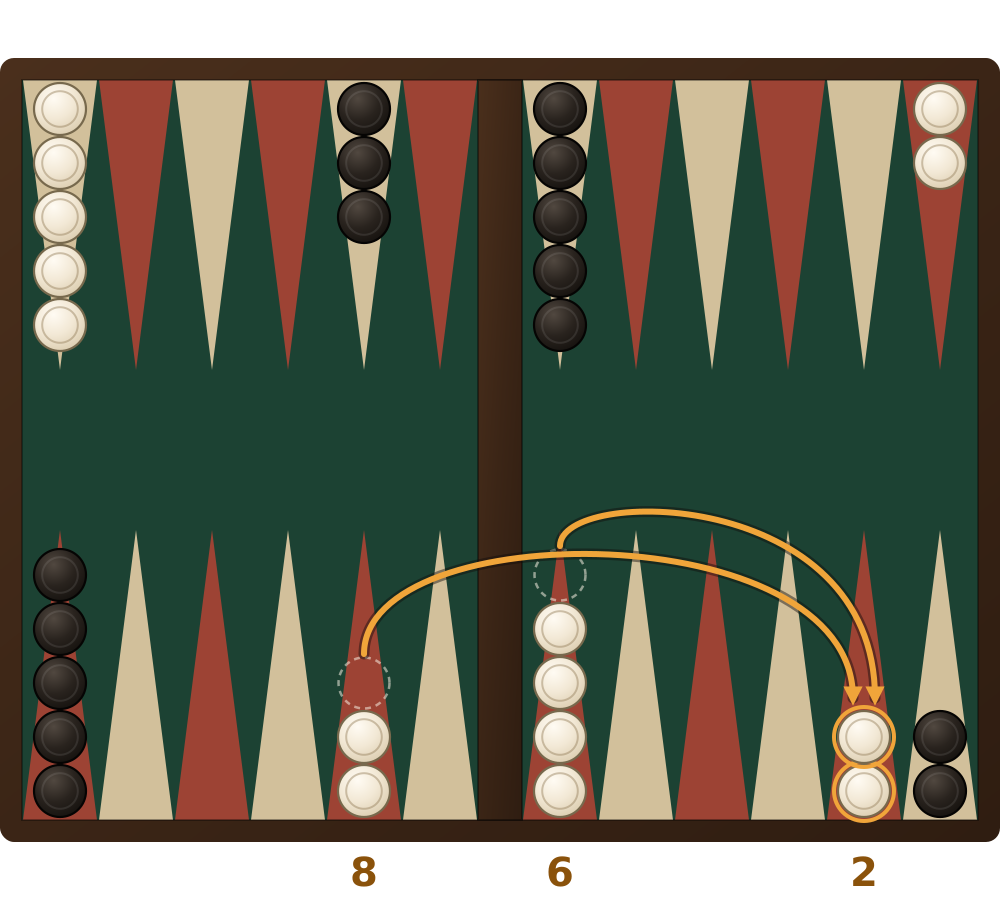
6-4
Make your 2-pointOne checker from 8 and one from 6, both to your 2-point.
Very deep, and only just ahead of two other plays. Also fine: one up, one down (24 to 18, 13 to 9), or a back checker from 24 to 14.
In notation: 8/2 6/2; also fine: 24/18 13/9, 24/14
Run
One roll carries a back checker all the way from 24 to 13: run it.
-
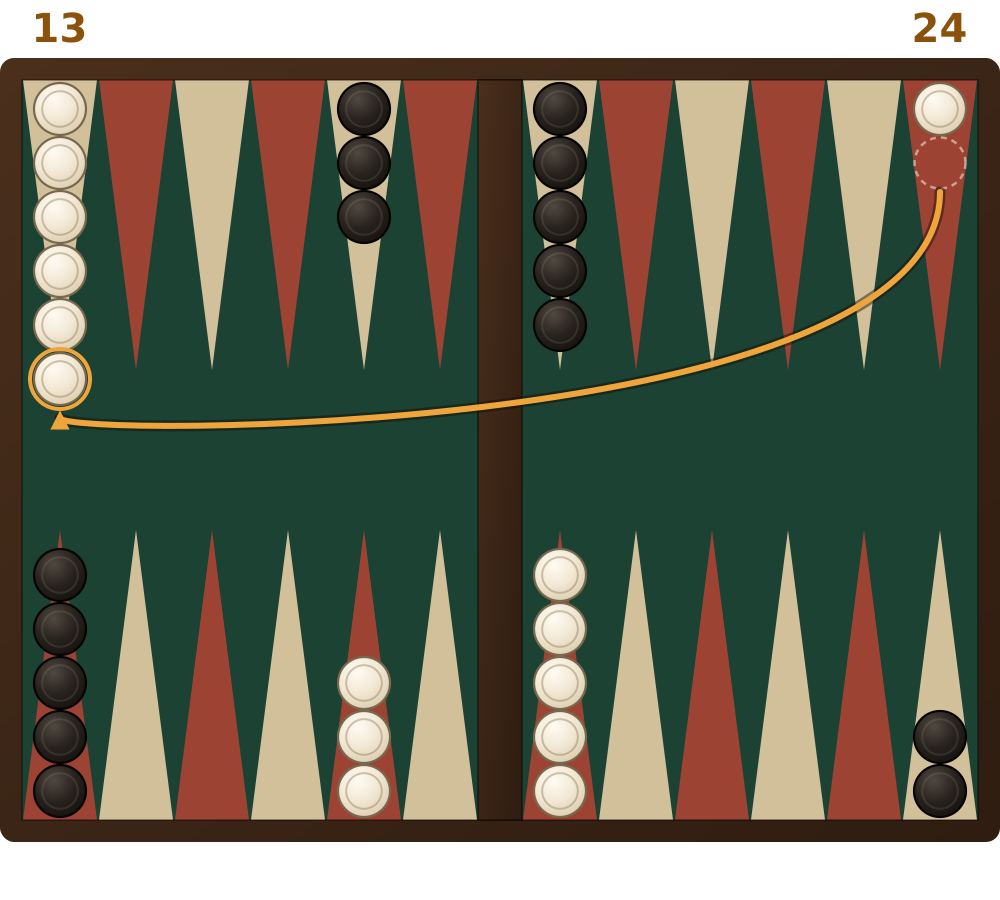
6-5
RunOne back checker from 24 all the way to 13.
It ends on your 13-point with five others, so nothing is left alone.
In notation: 24/13
No point to make: one up, one down
With the other nine rolls, no two checkers can meet on a good point. Do two useful jobs instead: move one back checker up, so it can escape or team up with its partner later, and bring one checker down from your 13-point, ready to make a point next turn. With 4-3, bringing two checkers down is just ahead.
-
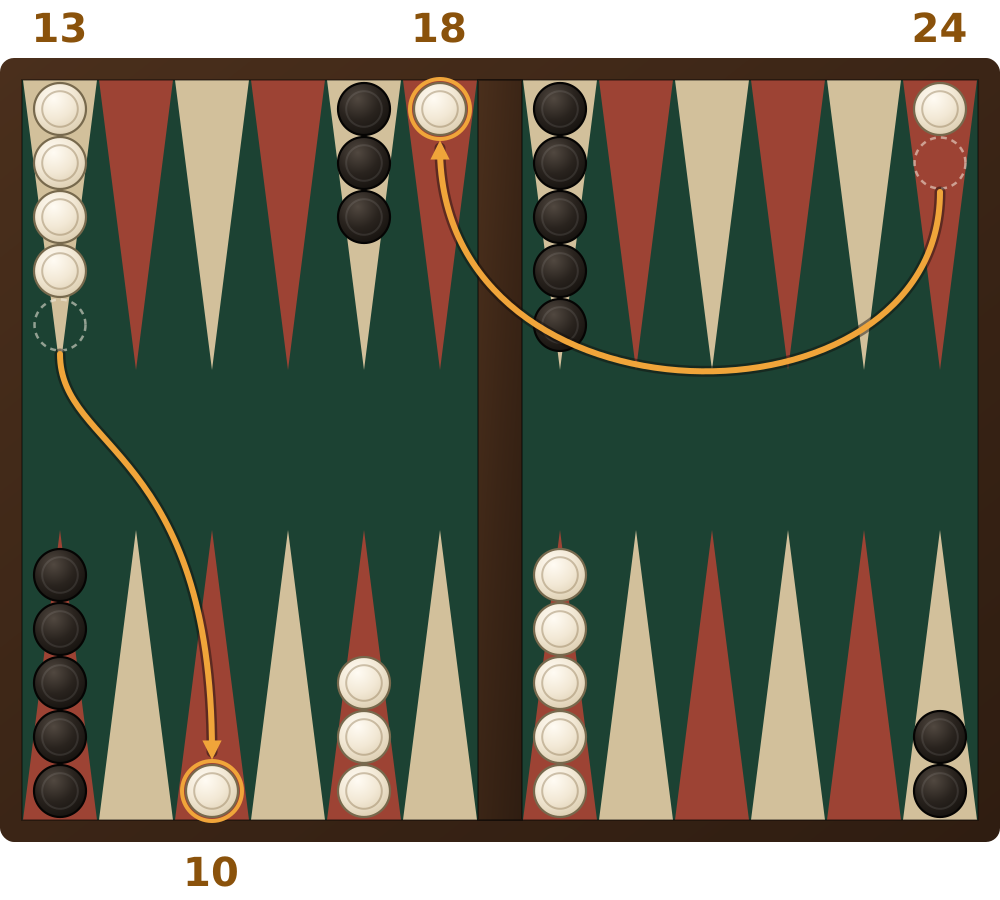
6-3
One up, one downA back checker from 24 to 18, and a checker from 13 to 10.
Both are in place to make a point next turn. Also fine: a back checker from 24 to 15.
In notation: 24/18 13/10; also fine: 24/15
-
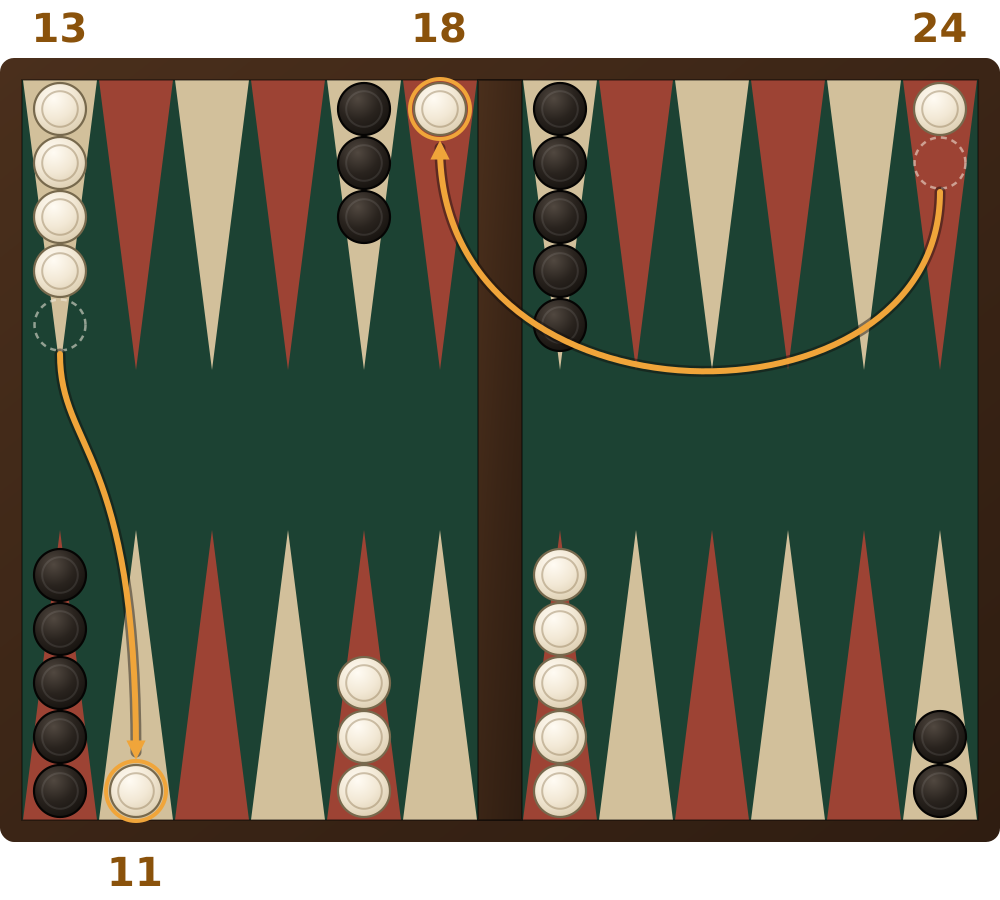
6-2
One up, one downA back checker from 24 to 18, and a checker from 13 to 11.
The checker on 11 can help make a point in or near your home board next turn.
In notation: 24/18 13/11
-
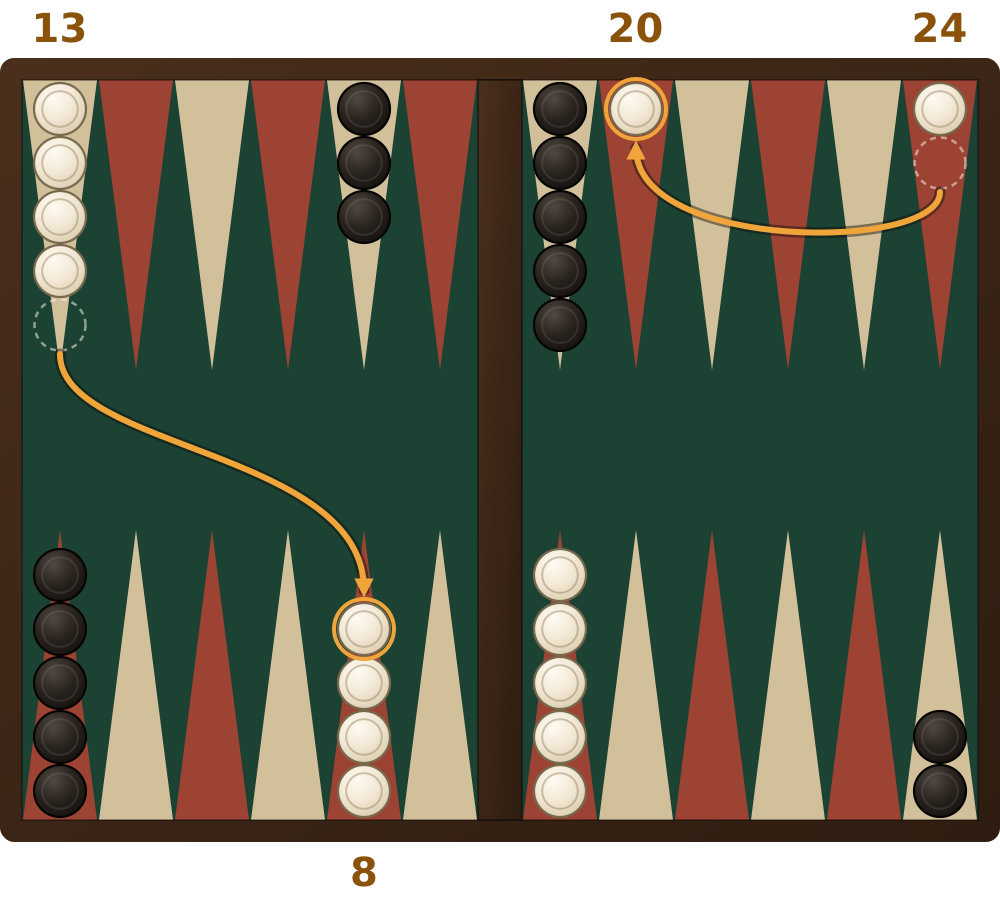
5-4
One up, one downA back checker from 24 to 20, and a checker from 13 to 8.
The checker on 8 is safe, and the one on 20 can later make a point in your opponent’s home board. Also fine: two down, from 13 to 9 and from 13 to 8.
In notation: 24/20 13/8; also fine: 13/9 13/8
-
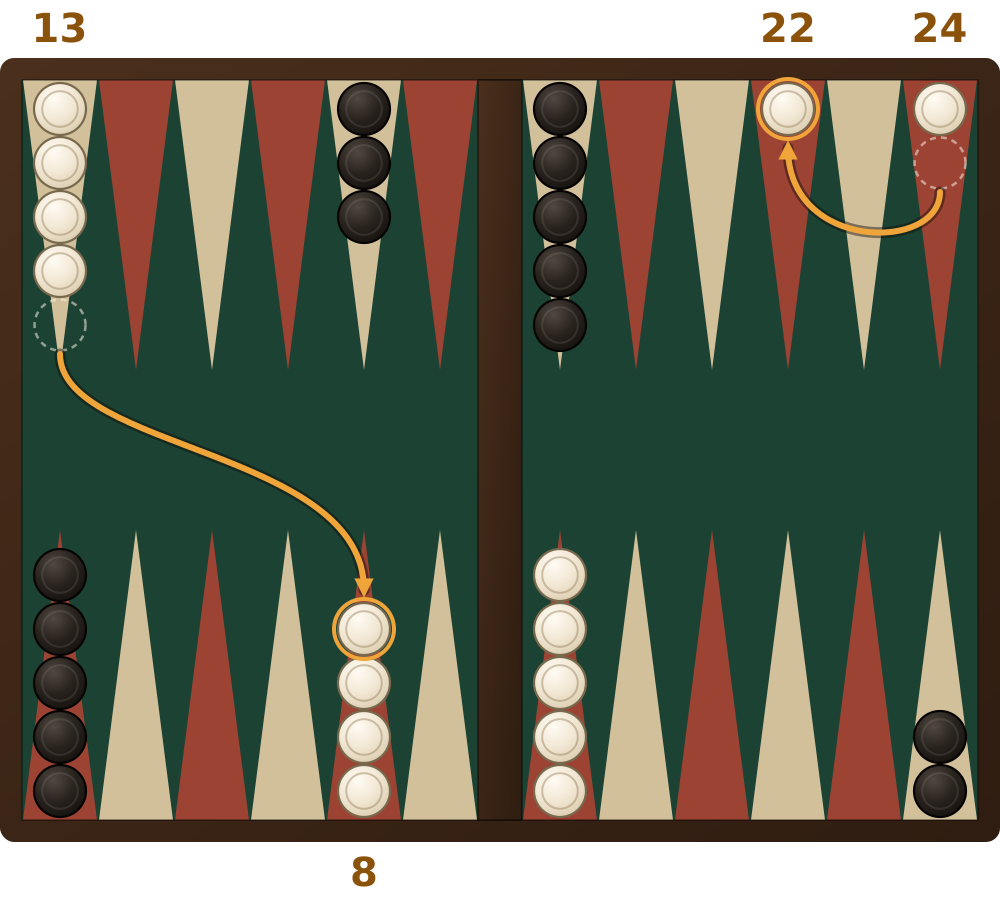
5-2
One up, one downA back checker from 24 to 22, and a checker from 13 to 8.
The checker on 8 lands safely, and the one on 22 can team up with its partner later. Also fine: two down, from 13 to 11 and from 13 to 8.
In notation: 24/22 13/8; also fine: 13/11 13/8
-
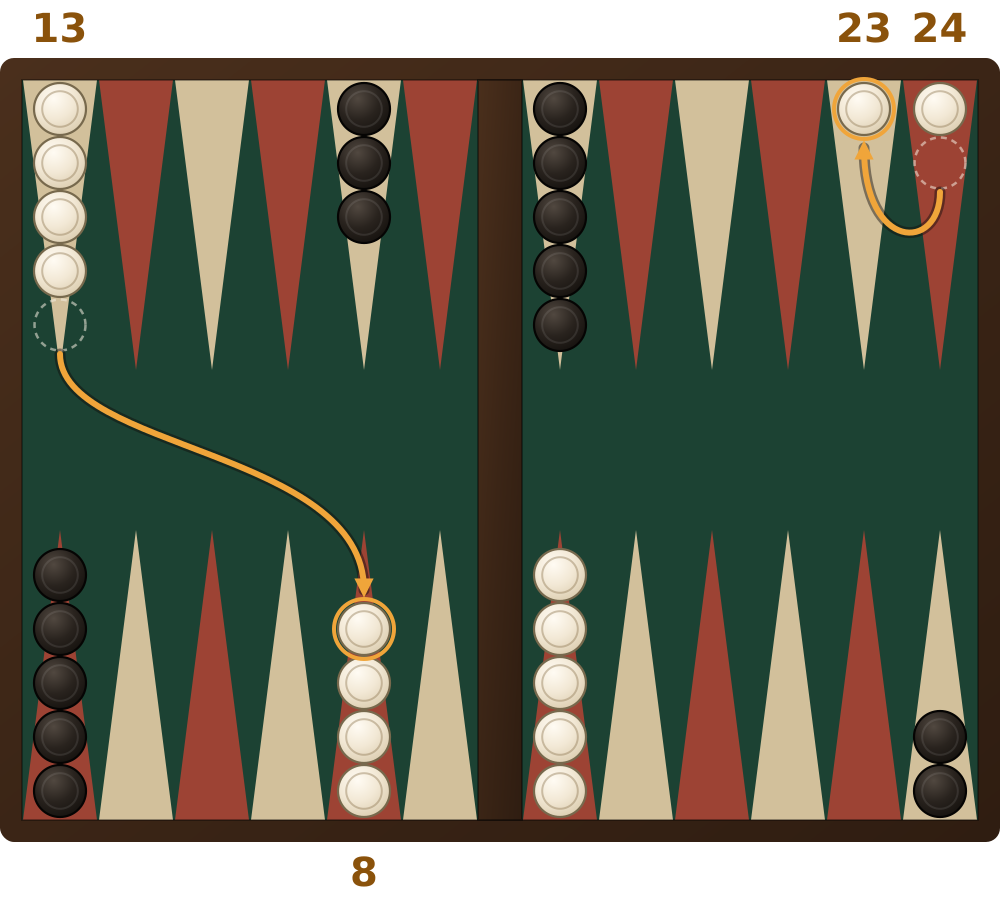
5-1
One up, one downA back checker from 24 to 23, and a checker from 13 to 8.
The 5 brings a checker safely to 8; the 1 splits your back checkers so they can make a point later.
In notation: 24/23 13/8
-
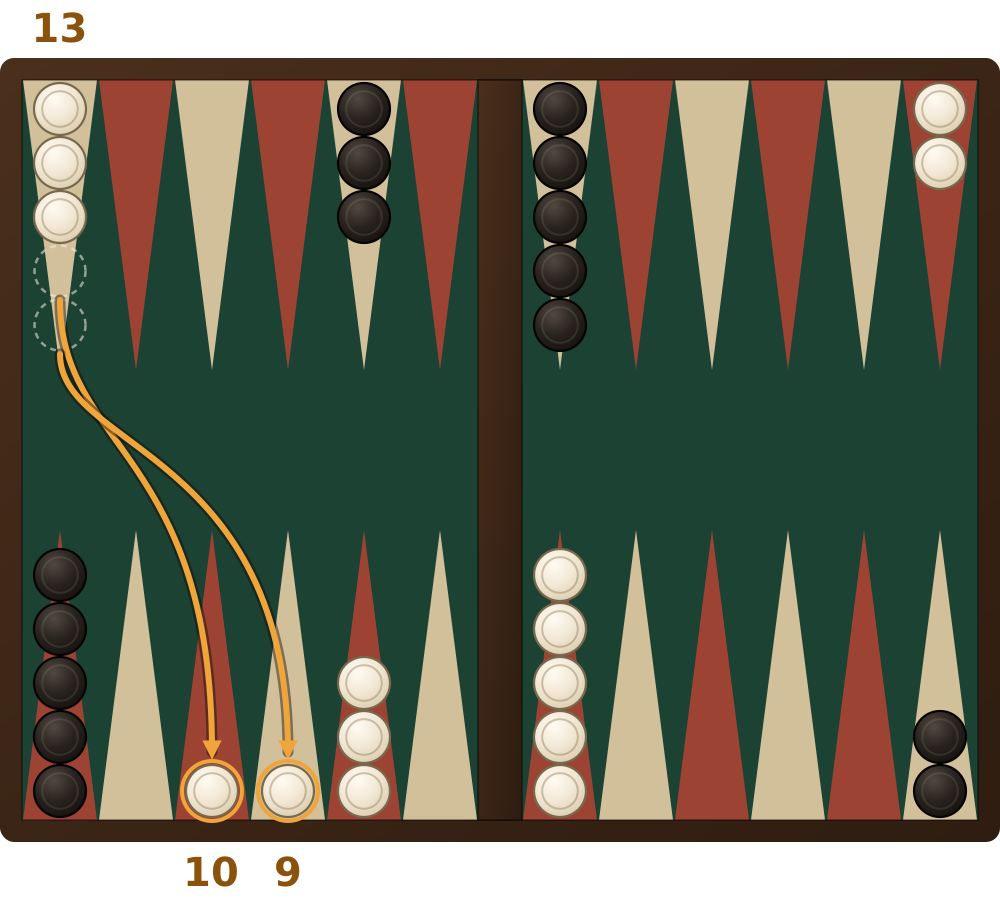
4-3
Two downTwo checkers from 13, one to 10 and one to 9.
Both are in place to make a point in your home board next turn. Also fine: one up, one down: 24 to 21 and 13 to 9, or 24 to 20 and 13 to 10.
In notation: 13/10 13/9; also fine: 24/21 13/9, 24/20 13/10
-
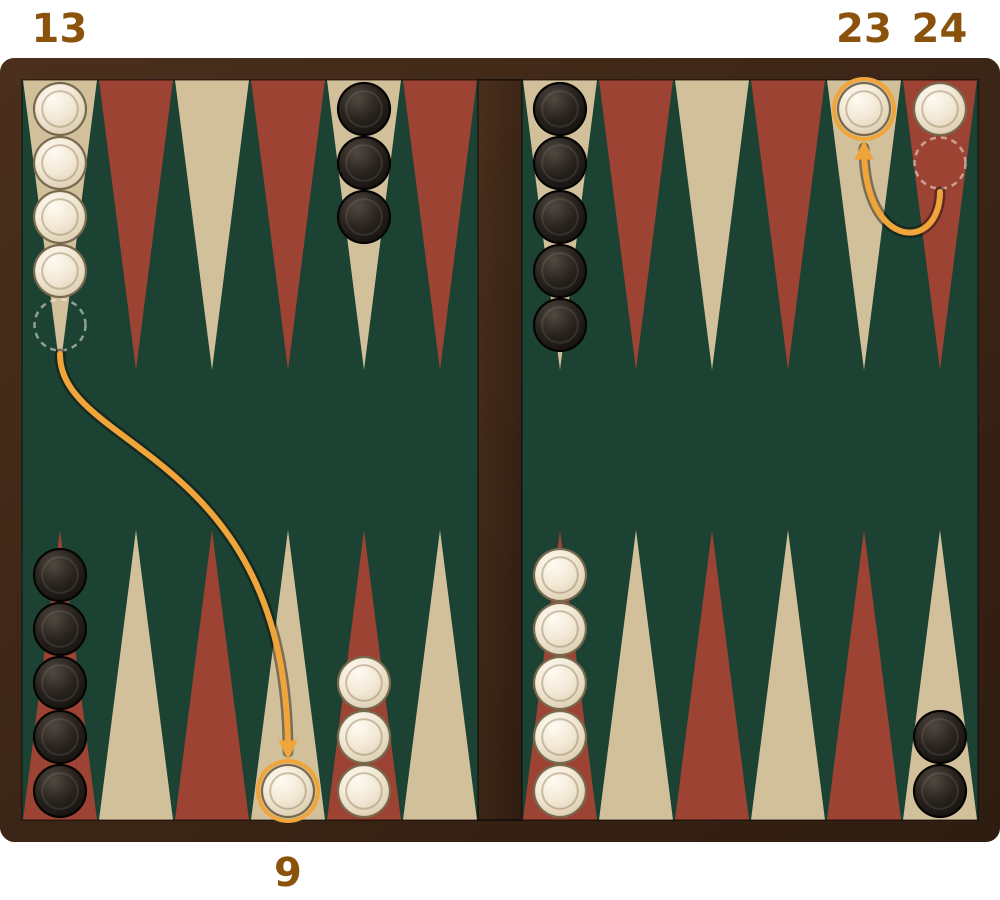
4-1
One up, one downA back checker from 24 to 23, and a checker from 13 to 9.
The 1 splits your back checkers; the 4 brings a checker within reach of your home board.
In notation: 24/23 13/9
-
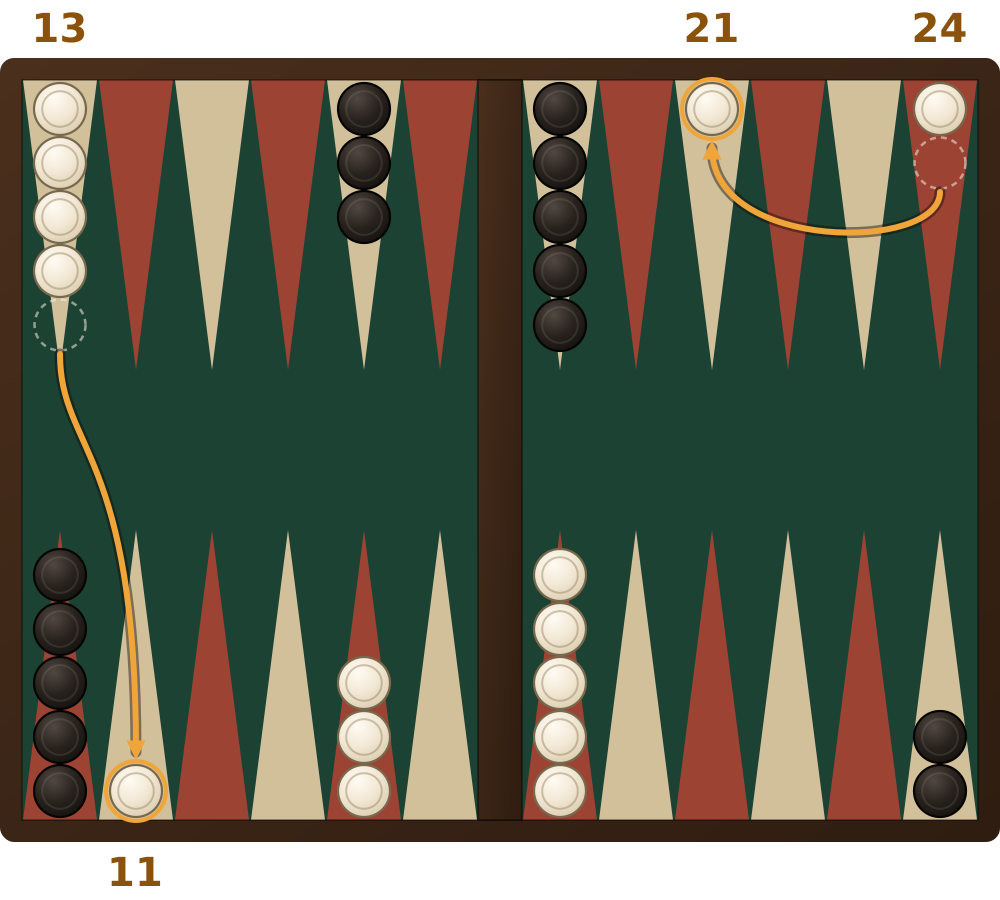
3-2
One up, one downA back checker from 24 to 21, and a checker from 13 to 11.
Both are in place to help make a point next turn. Also fine: two down, from 13 to 11 and from 13 to 10, or 24 to 22 and 13 to 10.
In notation: 24/21 13/11; also fine: 13/11 13/10, 24/22 13/10
-
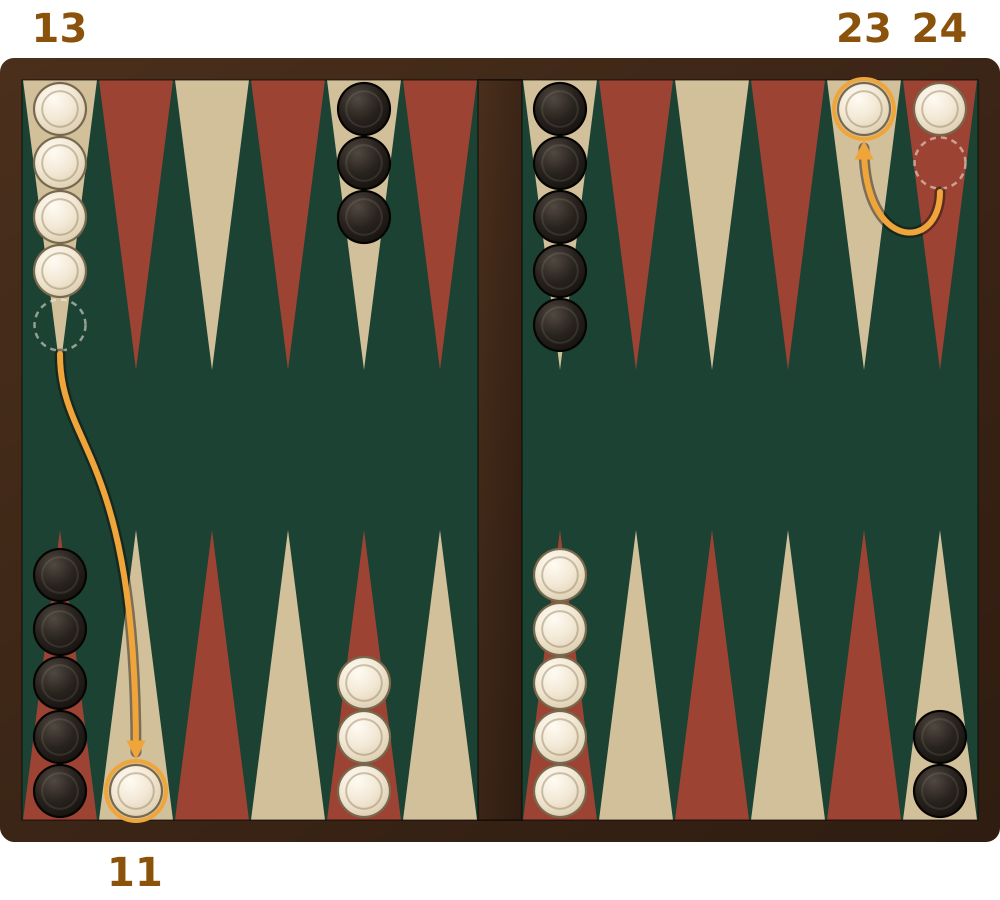
2-1
One up, one downA back checker from 24 to 23, and a checker from 13 to 11.
Little to move and no point to make: split the back checkers, bring one down. Also fine: 13 to 11 and 6 to 5, leaving a checker alone on your 5-point to cover next turn.
In notation: 24/23 13/11; also fine: 13/11 6/5
Does the first move matter much?
Less than it feels. A good 3-1 leaves you about 55% to win the game; a good 4-1, the weakest first roll, about 50%. The plays rated “also fine” are within a fraction of that. What matters more is not giving it back: most games are lost later, through big mistakes. How to get better at backgammon starts there.
Questions
- Why can’t the first roll be a double?
- Each player rolls one die to start, and the higher number moves first, playing both numbers. If the dice match, both roll again. So the first move is always one of the 15 mixed rolls. The rules of backgammon has the rest.
- And when my opponent moved first?
- The same plans hold, but the best play depends on what they did, and doubles come into it. Backgammon Room’s first course, First moves, teaches both on the board, in short lessons.
- What does the notation mean?
- “8/5 6/5” means a checker from your 8-point to your 5-point and one from your 6-point to your 5-point. Each number is a point counted from your side.
- Are these plays for matches too?
- They’re rated for a game played for points with the doubling cube. In a match, the score can change a close choice, such as 6-4 or 2-1; the clear ones, like 3-1 and 6-5, stay the same.
See also: backgammon dice odds and how to count pips.