
Backgammon rules
Last updated 28 October 2026
Backgammon is played by two players, each with 15 checkers, and two dice. You move your checkers round the board into your home board, then take them off it: the first to take off all 15 wins. The rules fit on one page, just below, and each has a section of its own after that.
The rules on one page
- The board. 24 points in four quarters of six, with the bar down the middle. Number them from your side: your home board is 1 to 6, your outer board 7 to 12, then your opponent’s outer board 13 to 18 and their home board 19 to 24.
- Setup. 15 checkers each: 2 on your 24-point, 5 on your 13-point, 3 on your 8-point and 5 on your 6-point. Your opponent does the same from their side.
- The aim. You move from 24 toward 1, round into your home board, then take your checkers off the board. Your opponent goes the other way. The first to take off all 15 wins.
- Who starts. Each player rolls one die. The higher number moves first, playing both dice as they landed. On a tie, both roll again.
- Moving. Each die moves one checker that many points. One checker can take both dice, one after the other. A checker can stop on any point except one where your opponent has two or more checkers, and that includes where it stops between the two dice.
- Doubles. Play the number four times.
- Using your roll. Play both dice if you can. If only one can be played, play it; if either can but not both, play the larger. If neither can, the turn is lost.
- Hitting. Stopping on a point where your opponent has a single checker hits it: it goes on the bar.
- Coming back in. A checker on the bar must come back in before any other checker moves, in your opponent’s home board: a 1 on your 24-point, a 6 on your 19-point. It can’t come in on a point with two or more of their checkers. If neither die brings it in, the turn is lost.
- Bearing off. Only once all 15 checkers are in your home board. A die takes off a checker from its own point. With none there, the die must move a checker down from a higher point; with none higher, it takes one off your highest point. You may always move inside the board instead. A checker hit meanwhile must come back home before you take off more.
- Winning. 1 point for a single game, 2 for a gammon (the loser has taken off no checker), 3 for a backgammon (none taken off and one still on the bar or in the winner’s home board), times the doubling cube.
- The doubling cube. It starts in the middle, at 1 (it shows 64). Before rolling, you may double. Your opponent takes, and the game goes on for twice as much, with the cube on their side: only they can double next. Or they pass, and lose the game at what it was worth before the double.
- Matches. Games are played until one player reaches a set number of points. Crawford rule: the first game after a player gets one point from winning the match is played without the cube.
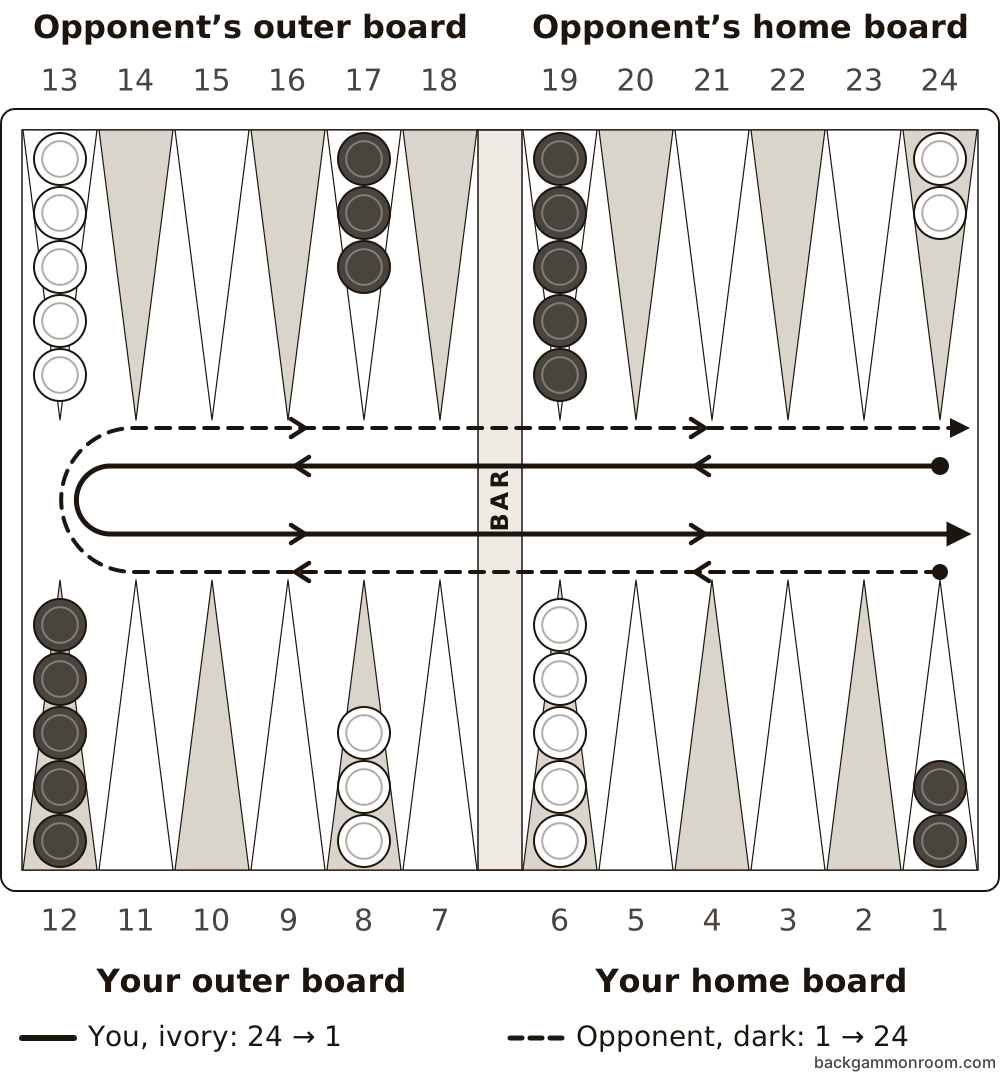
Backgammon rules · backgammonroom.com/rules-of-backgammon/ · updated 28 October 2026
The board and the checkers
The board has 24 long triangles, called points, in four quarters of six. The bar runs down the middle and splits it in two.
- Your home board: your points 1 to 6. Your checkers all have to get here.
- Your outer board: your points 7 to 12.
- Across the board, your opponent’s outer board (your 13 to 18) and their home board (your 19 to 24).
Each player numbers the points from their own side, so your 1-point is your opponent’s 24-point. You also need two dice each, or one pair to share, and the doubling cube, a large die marked 2, 4, 8, 16, 32 and 64.
Setting up
Each player puts out 15 checkers, counting from their own side: 2 on the 24-point, 5 on the 13-point, 3 on the 8-point and 5 on the 6-point.
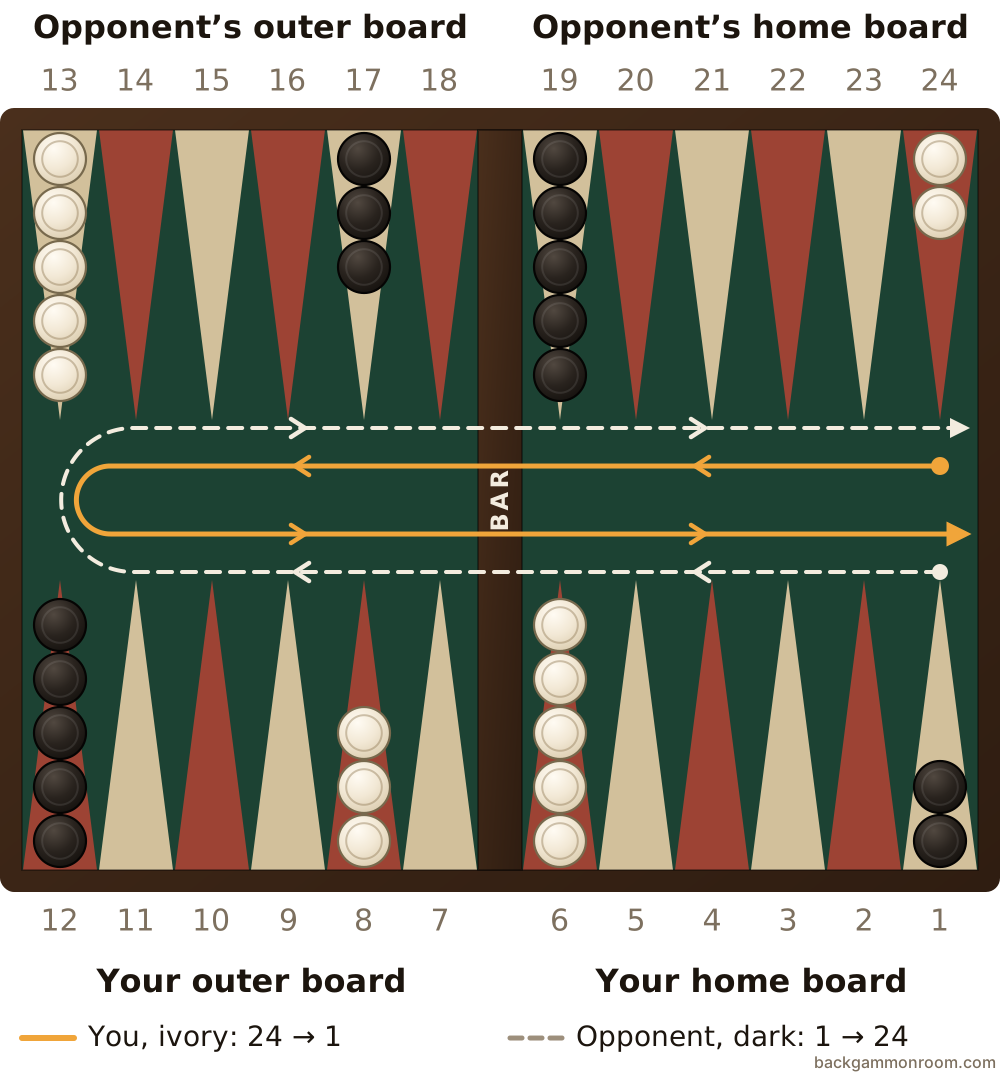
Who starts
Each player rolls a single die. The higher number moves first, playing both numbers rolled: their own and their opponent’s. If the dice match, both roll again, so the first move of a game is never a double. After that, players take turns rolling both dice. The best opening moves has a good play for each of the 15 first rolls.
Moving your checkers
You always move the same way, from your 24-point toward your 1-point: your checkers go round the board in a horseshoe, and your opponent’s go round the other way.
Each die is a move of its own. With 5-3, you move one checker 5 points and one checker 3, or one checker 5 and then 3. A checker can stop on a point that is:
- empty;
- yours already, however many checkers are there;
- held by a single checker of your opponent’s: you hit it (see below).
It can’t stop on a point where your opponent has two or more checkers: that point is closed. When one checker plays both dice, the point where it stops in between must be open too. A checker can jump over closed points; it just can’t land on them. Six closed points in a row make a wall no checker can get past.
Doubles
When both dice show the same number, you play that number four times. With 4-4, you have four moves of 4 points, shared however you like among one, two, three or four checkers. Each move has to stop on an open point, and if you can’t play all four, you play as many as you can.
Playing both dice
You must play both dice whenever you can, even when you’d rather not.
- If only one of the two numbers can be played, you play that one.
- If either can be played but not both, you play the larger.
- If neither can be played, the turn is lost.
When you have a choice, you can pick the play that uses both dice in any order you like.
Hitting and coming back in
A checker alone on a point is called a blot. If one of your checkers stops on it, you hit it: it goes on the bar, in the middle of the board.
A checker on the bar must come back in before its player moves anything else. It comes in to the opponent’s home board, on the point that matches a die: for you, a 1 brings it in on your 24-point and a 6 on your 19-point. The point has to be open: empty, yours, or held by a single checker of your opponent’s, which you hit as you come in.
If neither die brings it in, the turn is lost. When your opponent holds all six points of their home board, they have closed it: you wait until a point opens. With two checkers on the bar, both must come in before anything else moves. The odds of coming in go from 35 rolls of 36 against one closed point to 11 against five.
Bearing off
Once all 15 of your checkers are in your home board, you can start taking them off the board, called bearing off. Each die takes off a checker from the point with its number: a 4 from your 4-point, a 6 from your 6-point.
- An empty point, checkers higher up: if you have no checker on the die’s point but some on higher points, you must play that die by moving one of them down inside your home board.
- Nothing higher: if no checker stands higher than the die, you take one off from your highest point. With a 6 and checkers only on your points 1 to 4, a checker comes off your 4-point.
- Moving instead: you can always play a die inside your home board instead of taking a checker off.
For example, your last checkers are on your 5-, 3- and 2-points and you roll 6-4. The 6 takes off the checker on your 5-point. Then the 4 has no checker on your 4-point and none higher, so it takes off the one on your 3-point. Played the other way round, the 4 would have to move the checker on 5 down to 1 first.
If one of your checkers is hit while you’re bearing off, it has to come back in and get all the way home before you take off any more. The odds of bearing off your last two checkers are in their own table.
Single game, gammon, backgammon
The first player to take off all 15 checkers wins the game. What it’s worth depends on how far the loser got:
| Result | The loser | Points |
|---|---|---|
| Single game | has taken off at least one checker | 1 |
| Gammon | has taken off none | 2 |
| Backgammon | has taken off none, and still has a checker on the bar or in the winner’s home board | 3 |
The points are then multiplied by the doubling cube: a gammon with the cube on 4 is worth 8 points.
The doubling cube
The cube starts in the middle, on 64: it has no 1, and the game is worth 1 point. On your turn, before you roll, you may offer to double. Your opponent chooses:
- Take: the game goes on for 2 points, and the cube goes to their side. Only they can offer the next double, for 4 points.
- Pass: they lose the game at once, for what it was worth before your double.
Every double after that works the same way, up to 64. A rule of thumb for the decision: take when you’d still win at least 1 game in 4. How to get better at backgammon says more. In Backgammon Room, the review after each game tells you whether your doubles, takes and passes were right.
Matches
In a match, games are played one after another until a player reaches a number of points agreed beforehand, 5 or 7 for example. Points beyond the target don’t count. One rule is added, the Crawford rule: as soon as a player is one point from winning the match, the next game is played without the cube. The cube is back from the game after.
Each game usually starts with the opening roll. In Backgammon Room’s matches, the winner of each game starts the next one instead, rolling both dice. You play matches to 5 points against the bots, and to 1, 3 or 5 points online.
Rules some players add
In games played for points, some clubs agree on extra rules before they start:
- The Jacoby rule: gammons and backgammons count only once the cube has been turned.
- Beavers: a player who is doubled can take and double again at once, keeping the cube.
- Automatic doubles: a tie on the opening roll turns the cube to 2.
Backgammon Room uses none of them: gammons always count, and the cube goes up to 64.
Questions
- Do you need the exact number to bear off a checker?
- No. A die bigger than your highest point takes off a checker from that point. But while a checker stands higher than the die, you must play the die inside your home board.
- Can you choose not to play a die?
- No. If a die can be played, it must be, even when every way to play it hurts. Only a die that can’t be played is lost.
- Can you hit while bearing off?
- Yes. If your opponent has a checker alone in your home board, your checkers can still stop on it and hit it. They can hit yours too, and then you stop bearing off until it’s back home.
- Is a backgammon worth more than a gammon?
- Yes: a gammon is 2 points and a backgammon 3, both times the cube. A single game is 1.
- What if a die lands off the board or tilted?
- Both dice are rolled again. Players roll into the half of the board on their right, and both dice must land flat there.
See also: how to set up the board, the best opening moves and backgammon dice odds.