
How to set up a backgammon board
Last updated 28 October 2026
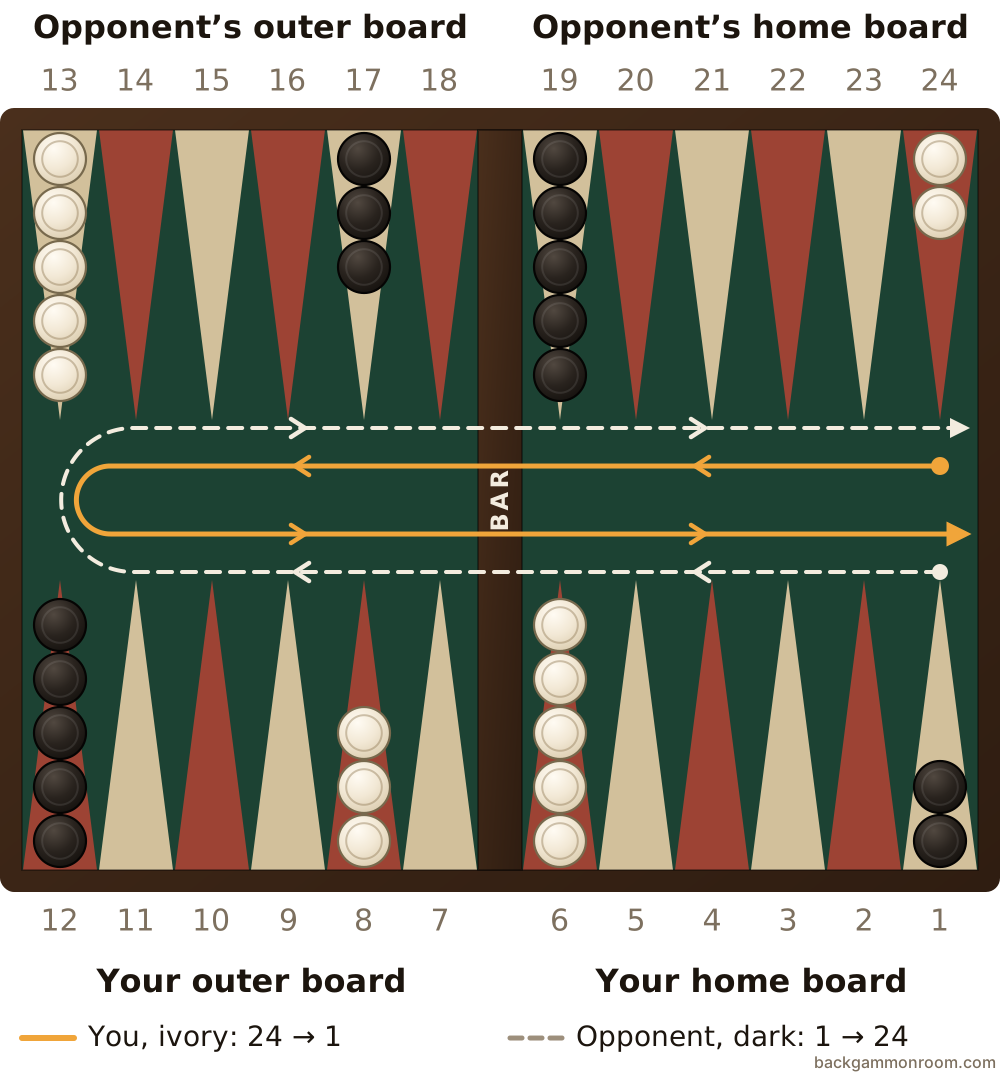
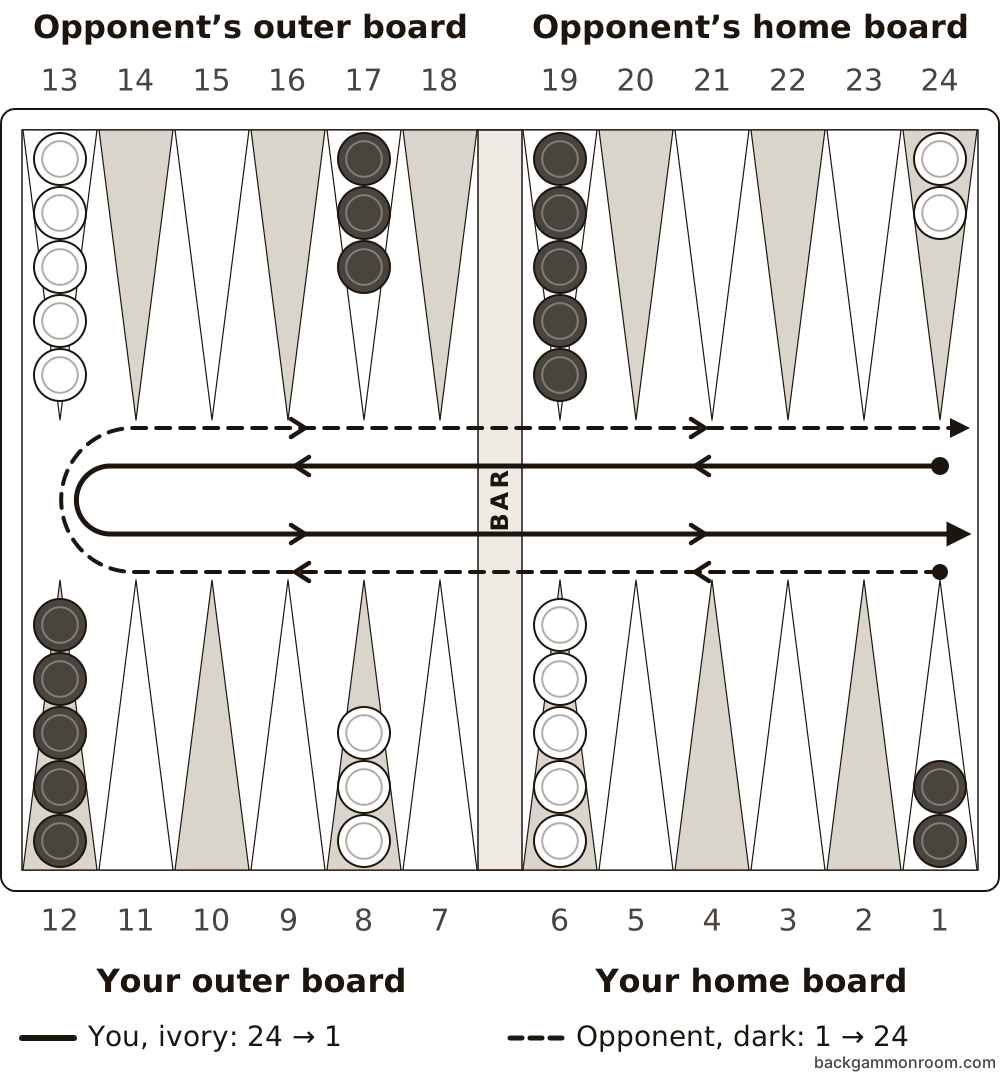
Each player has 15 checkers: 2 on their 24-point, 5 on their 13-point, 3 on their 8-point and 5 on their 6-point. Your opponent’s checkers sit on the same points counted from their side. You move from your 24-point round to your 1-point, into your home board; your opponent moves the other way.
Step by step
- Sit across from each other with the board between you. The board has 24 narrow triangles, called points, in four quarters of six, with the bar down the middle.
- Choose where the home boards go. Your home board is the quarter nearest you on your right, and your opponent’s is the one across from it. On the diagram, both are on the right. Some players put them on the left: everything is then a mirror image.
- Number the points from your side. Your 1-point is the corner of your home board; count 1 to 6 toward the bar, 7 to 12 across your outer board, then on your opponent’s side 13 to 18 back toward the bar and 19 to 24 in their home board, so 24 is across from your 1-point.
- 2 checkers on your 24-point, the far corner of your opponent’s home board. These are your back checkers.
- 5 checkers on your 13-point, the far corner of your opponent’s outer board, across from your 12-point. It’s called the midpoint.
- 3 checkers on your 8-point, in your outer board, two points from the bar.
- 5 checkers on your 6-point, in your home board, next to the bar.
- Your opponent does the same from their side. Their 24-point is your 1-point, their 13-point your 12, their 8-point your 17 and their 6-point your 19.
Check it: 2 + 5 + 3 + 5 makes 15 checkers each, and each side has a pip count of 167, the distance all its checkers have to travel.
Which way you move
You move your checkers from higher points to lower ones: from your 24-point along your opponent’s side of the board, round into your outer board and down into your home board. Once all 15 of your checkers are in your home board, you start taking them off the board, called bearing off. The first to bear off all 15 wins.
Your opponent goes the opposite way round, toward their own home board, across from yours. The two sides’ checkers pass each other on the way, which is where hitting and blocking happen. The rules of backgammon fit on one printed page.
Starting the game
- The first roll: each player rolls one die. The higher number moves first, playing both dice as they landed, so a first move is never a double. A tie is rolled again. The best play for each of the 15 first rolls is in its own guide.
- The doubling cube, if you play with it, starts on the bar, showing 64: it means the game is worth 1 point until someone doubles.
- Each player rolls in their own board, the half to their right, and both dice must land flat there.
Easy mistakes
- The home boards on different sides. They face each other: both on the right, or both on the left.
- The 3 checkers next to the bar. They go on the 8-point, two points from the bar; the point next to the bar, your 7-point, starts empty.
- The 5 checkers on your own side. Your midpoint, the 13-point, is on your opponent’s side of the board, across from your 12-point, where 5 of your opponent’s checkers stand.
Questions
- How many checkers does each player have?
- 15 each, in two colours. Here you play ivory and your opponent dark; on a real board, any two colours work.
- Which side is the home board on?
- Either, as long as both home boards are on the same side, facing each other. Most diagrams and apps, Backgammon Room included, put yours bottom right.
- What’s the starting pip count?
- 167 for each side: 2 × 24 + 5 × 13 + 3 × 8 + 5 × 6. How to count pips shows what to do with the count.
- Can I set up the board in the app?
- Backgammon Room sets it up for you. Its lessons start with the first roll on the real board, and you can play a friend on one iPhone, passing it across the table.
See also: the rules of backgammon, backgammon dice odds and how to get better at backgammon.